Researcher: Jaden Pieterse, Sol Plaatjie University Supervisor: Dr Martins Arosamwan, University of the Witwatersrand, Johannesburg
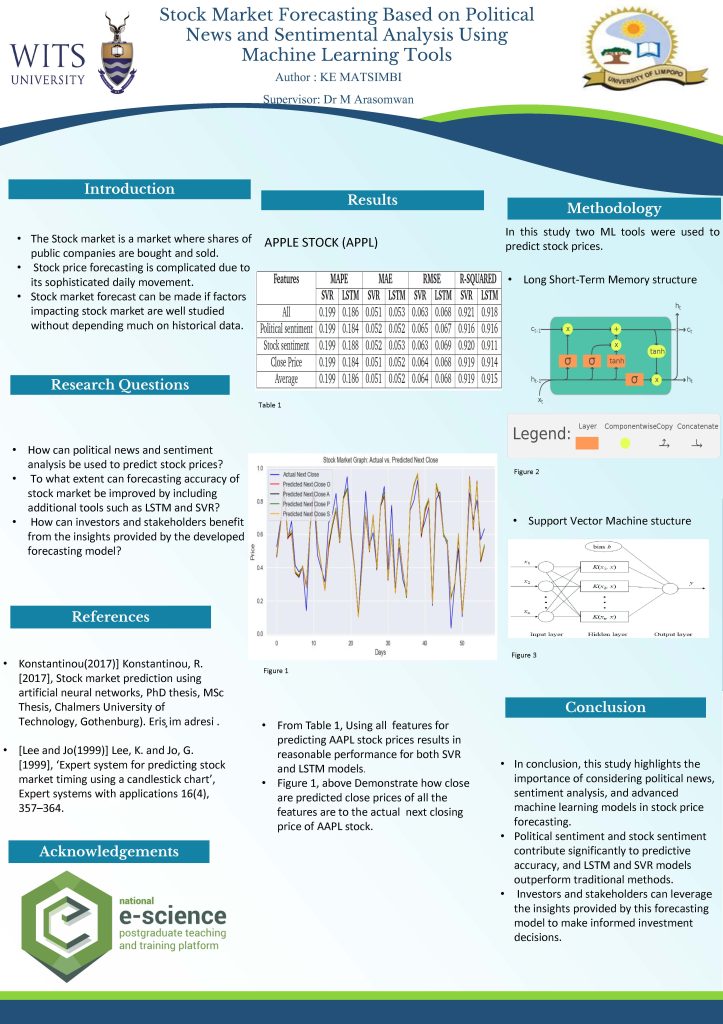
The need for accurate demand and sales forecasting is important for companies to perform better. Due to rapid technological development, e-commerce platforms face challenges with finding proper models to deal with market demand. LSTM is considered to perform best in predicting demand.
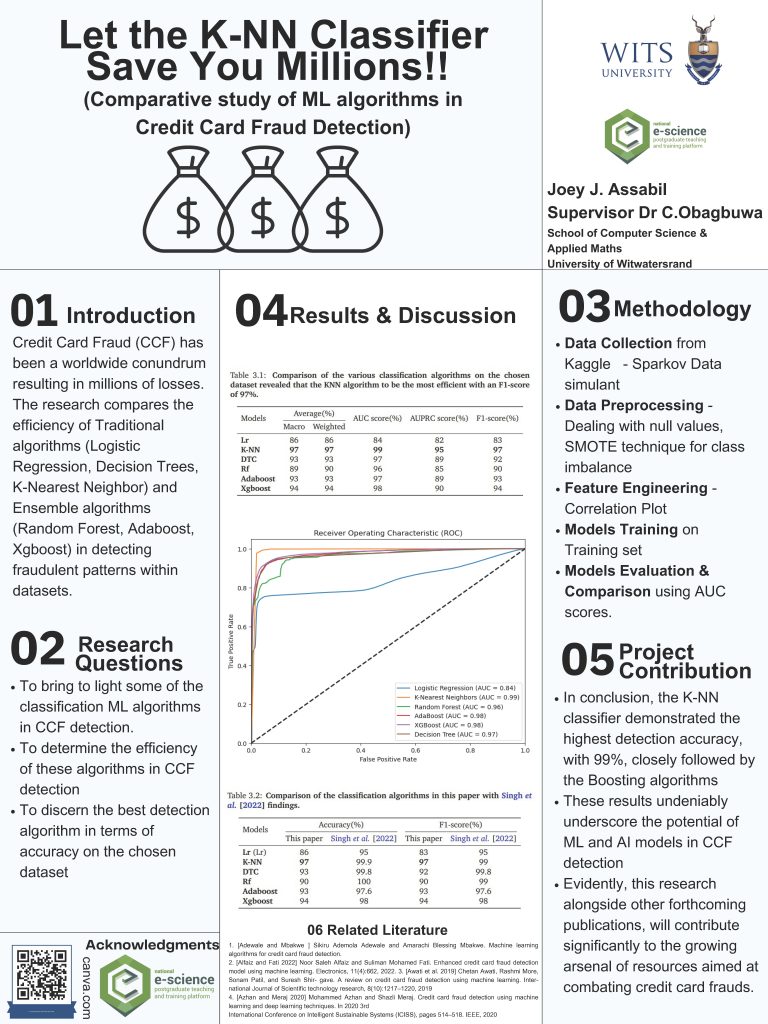
Researcher: Joey J. Assabil Supervisor: Dr C. Obagbuwa
Credit Card Fraud (CCF) hasbeen a worldwide conundrumresulting in millions of losses.The research compares theefficiency of Traditional algorithms (LogisticRegression, Decision Trees,K-Nearest Neighbor) andEnsemble algorithms(Random Forest, Adaboost,Xgboost) in detectingfraudulent patterns withindatasets.
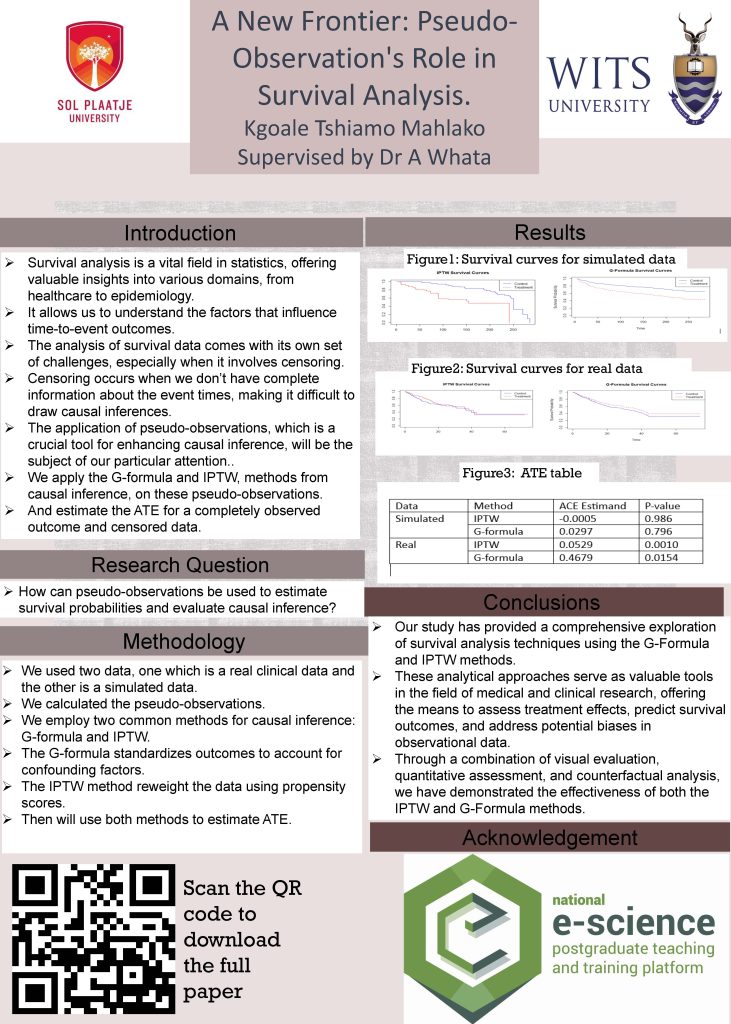
Researcher: Kgoale Tshiamo Mahlako Supervisor: Dr A Whata
Survival analysis is a vital field in statistics, offering valuable insights into various domains, from healthcare to epidemiology. It allows us to understand the factors that influence time-to-event outcomes. The analysis of survival data comes with its own set of challenges, especially when it involves censoring. Censoring occurs when we don’t have complete information about the event times, making it difficult to draw causal inferences. The application of pseudo-observations, which is a crucial tool for enhancing causal inference, will be the subject of our particular attention. We apply the G-formula and IPTW, methods from causal inference, on these pseudo-observations. And estimate the ATE for a completely observed outcome and censored data.
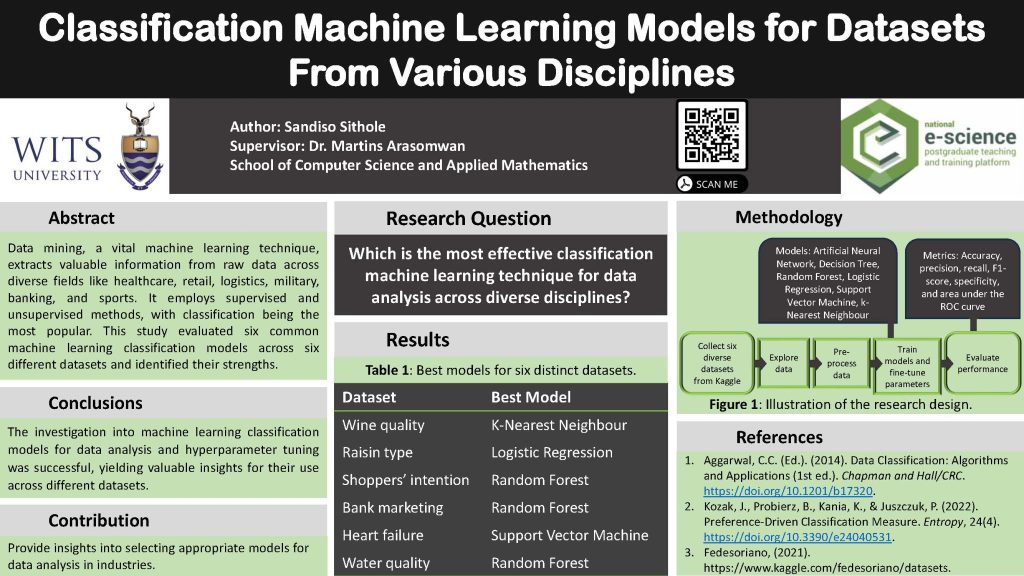
Data mining, a vital machine learning technique, extracts valuable information from raw data across diverse fields like healthcare, retail, logistics, military, banking, and sports. It employs supervised and unsupervised methods, with classification being the most popular. This study evaluated six common machine learning classification models across six different datasets and identified their strengths.
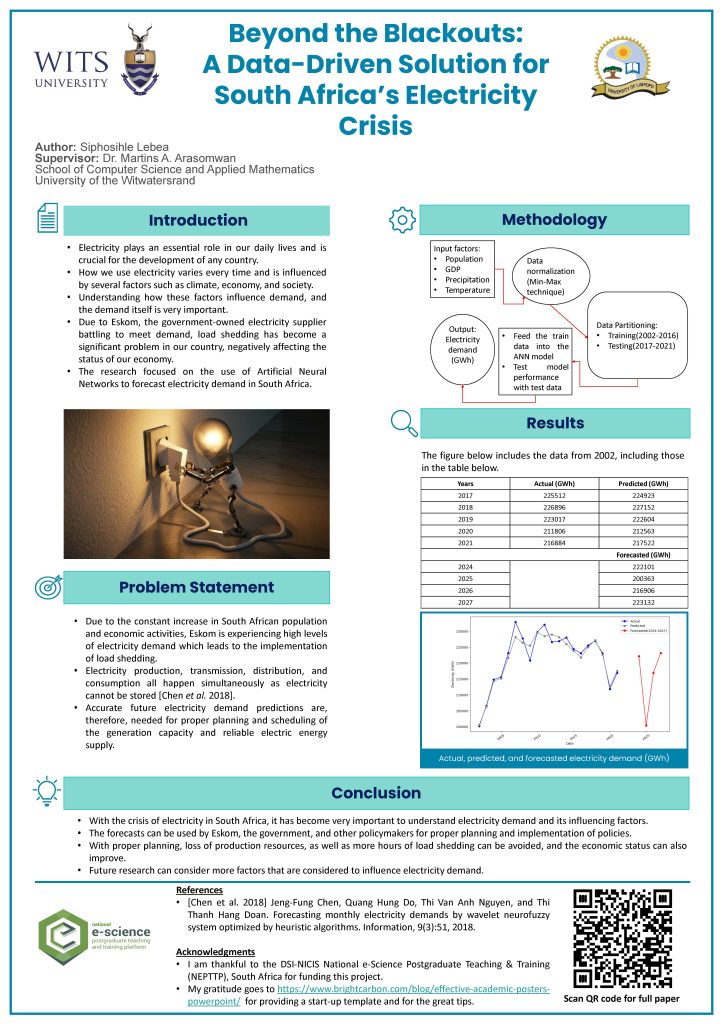
Researcher: Siphosihle Lebea, University of the Witwatersrand, Johannesburg Supervisors: Dr. Martins A. Arasomwan, University of the Witwatersrand, Johannesburg
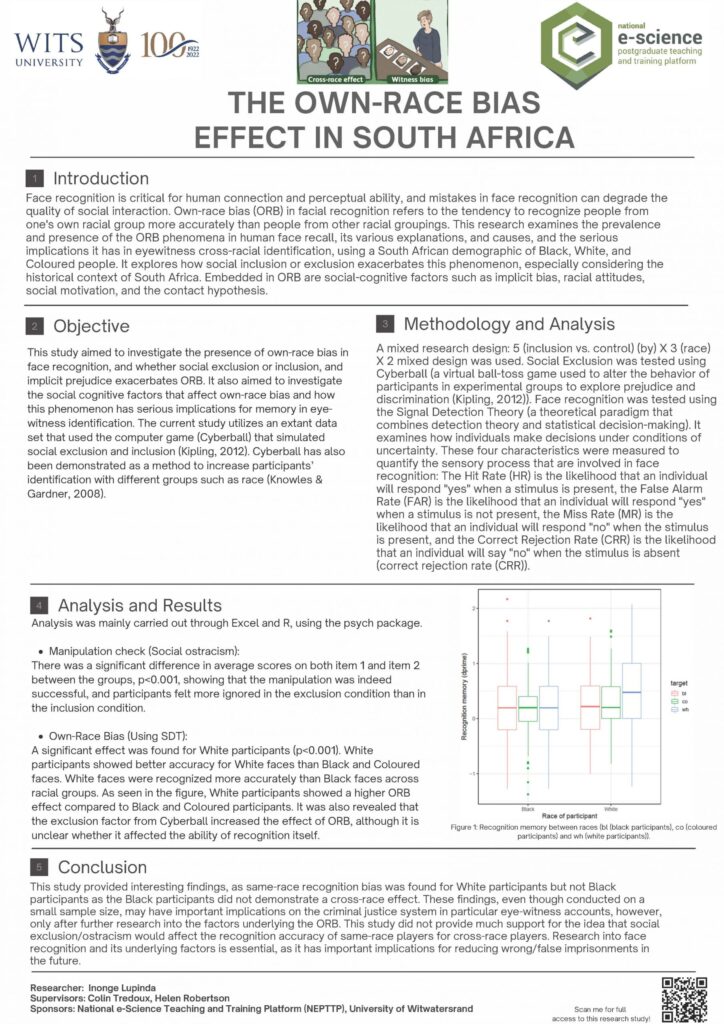
Researcher: Inonge Lupinda, University of the Witwatersrand, Johannesburg Supervisors: Dr Colin Tredoux, University of Cape Town and Dr Helen Robertson, University of the Witwatersrand, Johannesburg
Face recognition is critical for human connection and perceptual ability, and mistakes in face recognition can degrade the quality of social interaction. Own-race bias (ORB) in facial recognition refers to the tendency to recognize people from one’s own racial group more accurately than people from other racial groupings. This research examines the prevalence and presence of the ORB phenomena in human face recall, its various explanations, and causes, and the serious implications it has in eyewitness cross-racial identification, using a South African demographic of Black, White, and Coloured people. It explores how social inclusion or exclusion exacerbates this phenomenon, especially considering the historical context of South Africa. Embedded in ORB are social-cognitive factors such as implicit bias, racial attitudes, social motivation, and the contact hypothesis.
Researcher: Octavia Ndlovu, University of the Witwatersrand, Johannesburg Supervisor: Prof. Oliver Westerwinter, University of the Witwatersrand, Johannesburg
This paper gives a foundation to the first of many research paper that look into testing the relationship between good governance and the participation of Intergovernmental organisations in the type of Transnational governance initiatives. I hope to achieve these results through the use of two data sets that will be merged for the best results and that is using Transnational Public-Private Governance Initiatives in World Politics Data, together with data from Worldwide Governance Indicator. This paper doesn’t hope to achieve much beyond the scales of knowing if good governance is the reason of the participation og so much Intergovernmental organisation, I hope the results of this paper will help policy makers into making policies that will help benefit the world at a global scale, where IGOs have a good governance reason for being a part of TGIs.
Researcher: Hlayisani Khoza, University of Limpopo Supervisor: Dr Hairong Bau, University of the Witwatersrand, Johannesburg
In the financial industry forecasting, client attrition is critical. The expense of hiring fresh clients is significantly greater than the expense of maintaining current clients. There are several Machine Learning (ML) models in use to forecast client attrition, and the results are impressive. The issue with these models is their lack of openness and interpretability. Deep Learning (DL) models are the leading models in this development because of the layered non-linear structure, which provides no insight into how they reach at their results, these strong models have been dubbed “Black Boxes”. To deal with this problem Explainable methods have been used to explain these model outcomes. In this research, Shapley Additive method has been applied to the Multilayer Perceptron model to explain its result and it has been found to explain banking customer churn better.

 Written by Diane15 May 2025