Strange bedfellows: ANC-DA Parliamentary discourse in the GNU – A Corpus-Assisted Discourse Analysis

Researcher: Maxwell Milella, University of the Witwatersrand, Johannesburg
Supervisor: Dr Rod Alence and Dr Retha Langa, University of the Witwatersrand, Johannesburg

young democracy. After 30 years of unchallenged political dominance, the African National Congress (ANC) lost the parliamentary majority that it had held since South Africa’s first truly free and democratic election in 1994. In response to this, the ANC and 9 other parties from across South Africa’s political landscape came together to form a grand coalition government, a Government of National Unity (GNU).

The GNU is (at time of writing) dominated by two parties: the ANC and the Democratic Alliance (DA), historically the governing party and primary opposition since 1994 respectively. With a shared history of continuous enmity, relations between these parties have typically been cool, characterised by finger-pointing and antagonism. However, 2024’s coalition moment fundamentally altered the dynamic
between these parties, and their cooperation is essential for the effectiveness and longevity of the GNU.
Understanding the state of ANC-DA relations is crucial to understanding the dynamics of the GNU and assessing its trajectory. Indeed, tensions remain high between the ANC and DA, and have come to a boiling point numerous times in the GNU’s short lifespan so far. In particular, three policy issues have rocked the GNU, primarily through ANC-DA conflict: the National Health Insurance Act (NHI), the Basic
Education Laws Amendment Act (BELA) and the Expropriation Act. These policy issues, key coalition friction points, were the centre of this study’s analysis of ANC-DA friction in the GNU era, and its implications for the GNU overall. Specifically, through an analysis of parliamentary debate regarding these issues, this study sought to answer the following research questions:

To what may these patterns be attributed? (e.g. fundamental party ideology,
alleged issues of feasibility, etc.). Are there any notable patterns in the ANC and DA’s discourse related to the
NHI, the BELA and the Expropriation Acts? How do they each frame these
issues? What do these patterns reveal about the parties employing them?

 

Read More

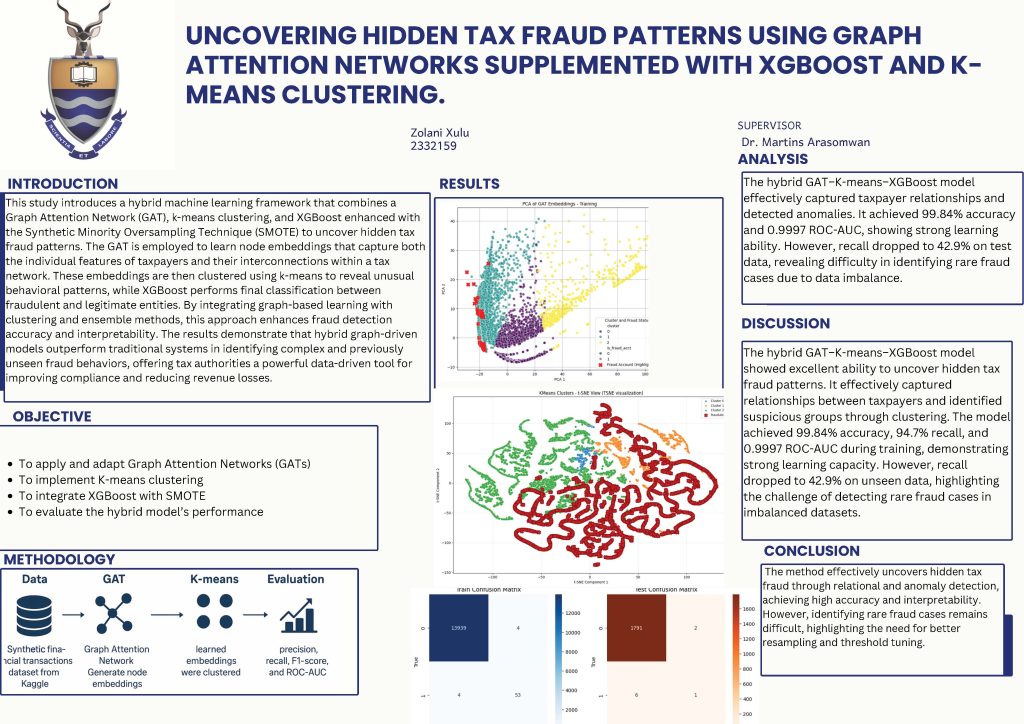
Uncovering hidden tax fraud patterns using graph attention networks supplemented with XGBoost and KMeans clustering

Researcher: Zolani Xulu, University of the Witwatersrand, Johannesburg
Supervisor: Dr. Martins Arasomwan, University of the Witwatersrand, Johannesburg

This study introduces a hybrid machine learning framework that combines a Graph Attention Network (GAT), k-means clustering, and XGBoost enhanced with the Synthetic Minority Oversampling Technique (SMOTE) to uncover hidden tax fraud patterns. The GAT is employed to learn node embeddings that capture both the individual features of taxpayers and their interconnections within a tax
network. These embeddings are then clustered using k-means to reveal unusual behavioral patterns, while XGBoost performs final classification between fraudulent and legitimate entities. By integrating graph-based learning with clustering and ensemble methods, this approach enhances fraud detection
accuracy and interpretability. The results demonstrate that hybrid graph-driven models outperform traditional systems in identifying complex and previously unseen fraud behaviors, offering tax authorities a powerful data-driven tool for improving compliance and reducing revenue losses.


Read More

From Ancestors to Algorithms: Traditional Healers Views on Mental Illness in the Digital Age

Researcher: Tshilidzi Rathogwa, University of the Witwatersrand, Johannesburg
Supervisor: Tasneem Haseem, University of the Witwatersrand, Johannesburg

There is a high prevalence of mental illness in South Africa, with limited access to formal care. Traditional healers serve as a crucial and culturally resonant first line of support for many communities. Online mental health discourse is largely dominated by Western biomedical perspectives, marginalizing indigenous knowledge. A new phenomenon is emerging as traditional healers begin to share their perspectives on digital platforms like YouTube. This study investigates how traditional healers
represent mental illness online and how the public engages with these views.


Read More

A Comparative Analysis of the Impact of Foreign Aid on Development in Africa

Researcher: Rorisang Motlogelwa, University of the Witwatersrand, Johannesburg
Supervisor: Dr Ekeminiabasi Eyita-Okon, University of the Witwatersrand, Johannesburg

This study examines how the impact of foreign aid on development varies across Africa from 2013 to 2022. Drawing on Amartya Sen’s (1999) development as freedom framework, development is assessed through indicators such as primary school enrollment, prevalence of undernourishment, life expectancy, voice and accountability, and GNI per capita. Using panel data methods, the analysis finds that the effects of aid vary across regions and between sectors. Governance emerges as a key moderator: in some instances,  weak governance can hinder development but interacts positively with aid, while in others good governance enhances outcomes yet may reduce aid’s effectiveness. The findings underscore the uneven influence of aid across Africa and sectors and highlight the need for sector-specific and longer-term analyses.


Read More

Security and development in practice: a quantitative analysis of the Nexus

Researcher: Lemohang Mosoeunyane, University of the Witwatersrand, Johannesburg
Supervisor: Dr C. Monjane, University of the Witwatersrand, Johannesburg

This study investigates the security-development nexus (SDN) through a cross-national quantitative analysis that moves beyond case-specific and largely theoretical debates. It assesses the extent to which stability translates into development and identifies the conditions that shape this relationship, guided by
the following research question: To what extent does security affect countries’ development outcomes?


Read More

Using discrete emotions and review discrepency to predict the helpfulness of mobile app reviews

Researcher: Mpho Modise, University of the Witwatersrand, Johannesburg
Supervisor: Dr S. Verkijika, University of the Witwatersrand, Johannesburg

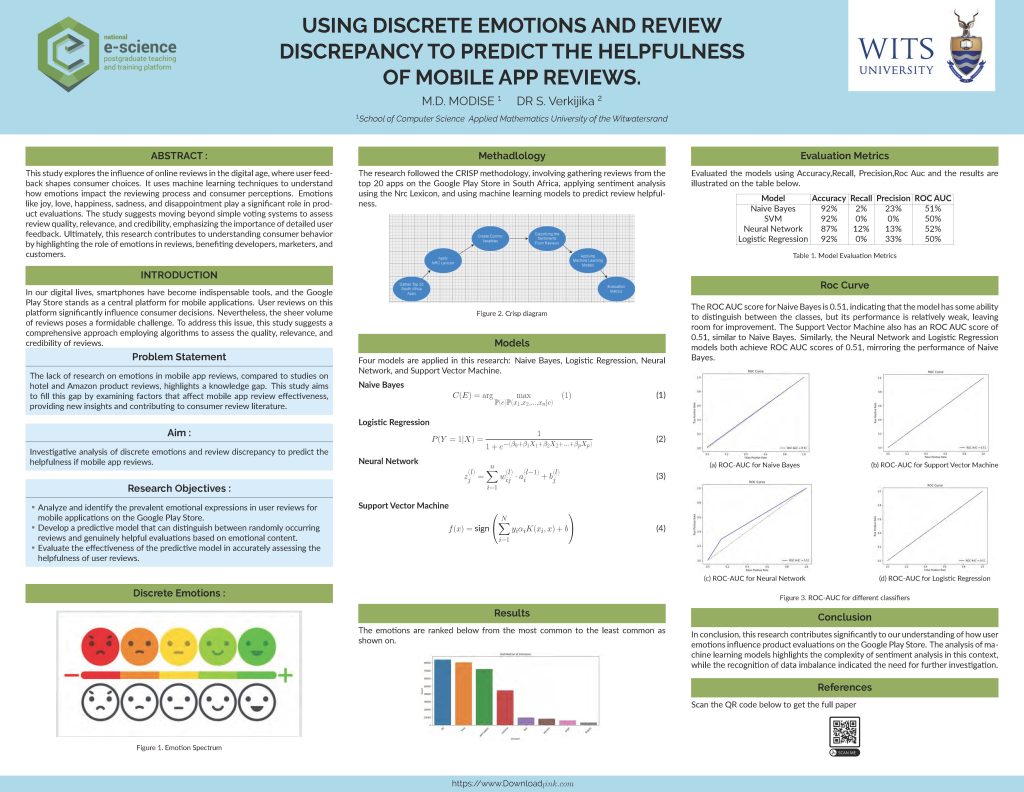
In our digital lives, smartphones have become indispensable tools, and the Google
Play Store stands as a central platform for mobile applications. User reviews on this
platform significantly influence consumer decisions. Nevertheless, the sheer volume
of reviews poses a formidable challenge. To address this issue, this study suggests a
comprehensive approach employing algorithms to assess the quality, relevance, and
credibility of reviews.


Read More

Safe urban futures: exploring the nexus between urban safety and quality of life in South African cities

Researcher: Lerato Tlale, University of the Witwatersrand, Johannesburg
Supervisor: Helen Sarah Robertson, University of the Witwatersrand, Johannesburg

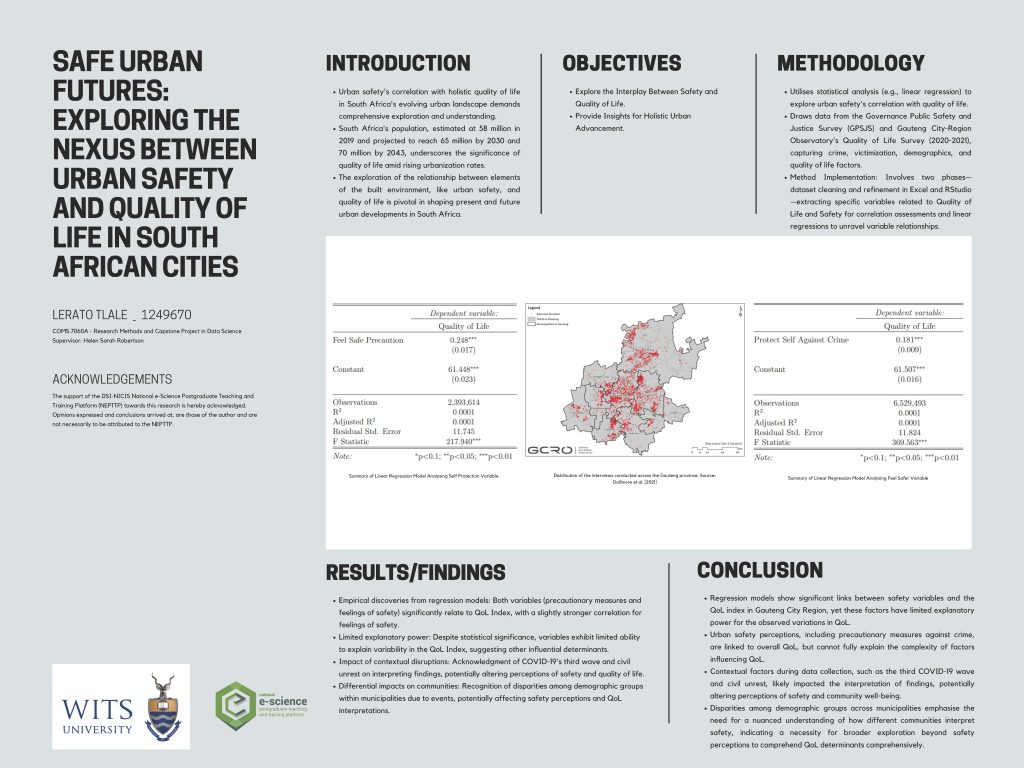
Urban safety’s correlation with holistic quality of life in South Africa’s evolving urban landscape demands comprehensive exploration and understanding.
South Africa’s population, estimated at 58 million in2019 and projected to reach 65 million by 2030 and 70 million by 2043, underscores the significance of quality of life amid rising urbanization rates.
The exploration of the relationship between elements of the built environment, like urban safety, and quality of life is pivotal in shaping present and future urban developments in South Africa.


Read More

Temporal Dependency Modeling in Financial Markets

Researcher: Small Tshithavhana, University of the Witwatersrand, Johannesburg
Supervisor: Dr. Walter Mudzimbabwe, University of the Witwatersrand, Johannesburg

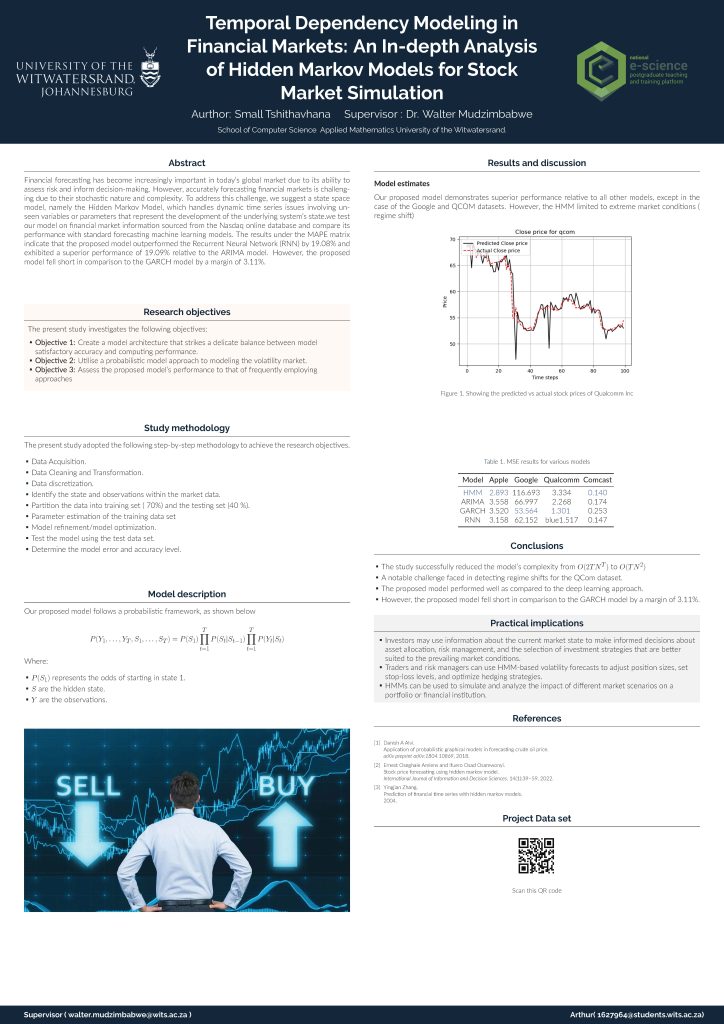
Financial forecasting has become increasingly important in today’s global market due to its ability to
assess risk and inform decision-making. However, accurately forecasting financial markets is challenging
due to their stochastic nature and complexity. To address this challenge, we suggest a state space
model, namely the Hidden Markov Model, which handles dynamic time series issues involving unseen
variables or parameters that represent the development of the underlying system’s state.we test
our model on financial market information sourced from the Nasdaq online database and compare its
performance with standard forecasting machine learning models. The results under the MAPE matrix
indicate that the proposed model outperformed the Recurrent Neural Network (RNN) by 19.08% and
exhibited a superior performance of 19.09% relative to the ARIMA model. However, the proposed
model fell short in comparison to the GARCH model by a margin of 3.11%.


Read More

Comparison of ensemble nlearning and neural network models for default risk analysis: a reproduction study

Researcher: Tebogo Malatsi, University of the Witwatersrand, Johannesburg
Supervisor: Assoc. Prof. YudhvirSeetharam, University of the Witwatersrand, Johannesburg

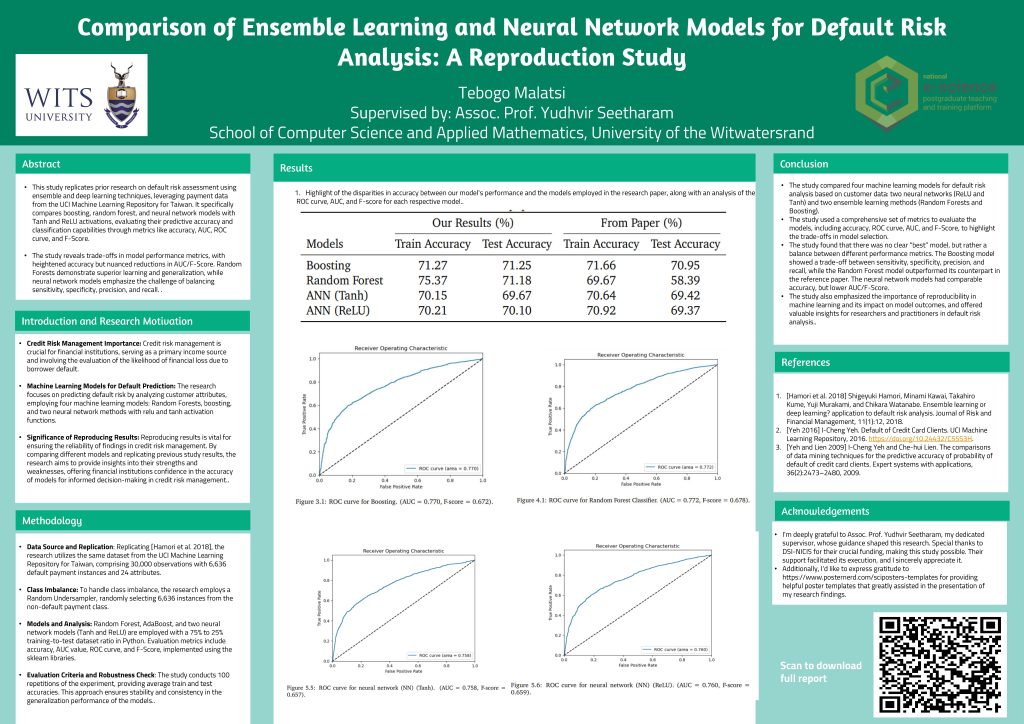
This study replicates prior research on default risk assessment using ensemble and deep learning techniques, leveraging payment data from the UCI Machine Learning Repository for Taiwan. It specifically compares boosting, random forest, and neural network models with Tanh and ReLUactivations, evaluating their predictive accuracy and classification capabilities through metrics like accuracy, AUC, ROC curve, and F-Score.
The study reveals trade-offs in model performance metrics, with heightened accuracy but nuanced reductions in AUC/F-Score. Random Forests demonstrate superior learning and generalization, while neural network models emphasize the challenge of balancing sensitivity, specificity, precision, and recall.


Read More